
1. Home
  2. Products
  3. MESE 2.0

Business simulation · running a company

MESE 2.0

Five years in the life of a company, in an hour and a half. Teams run competing companies in a shared market. After the game, the debrief shows what drives your managers’ decisions: this year’s profit or the value of the company.

  • up to 6 teams of 5
  • 1–1.5 hours of play + debrief
  • AZ · RU · EN
  • in the room or online
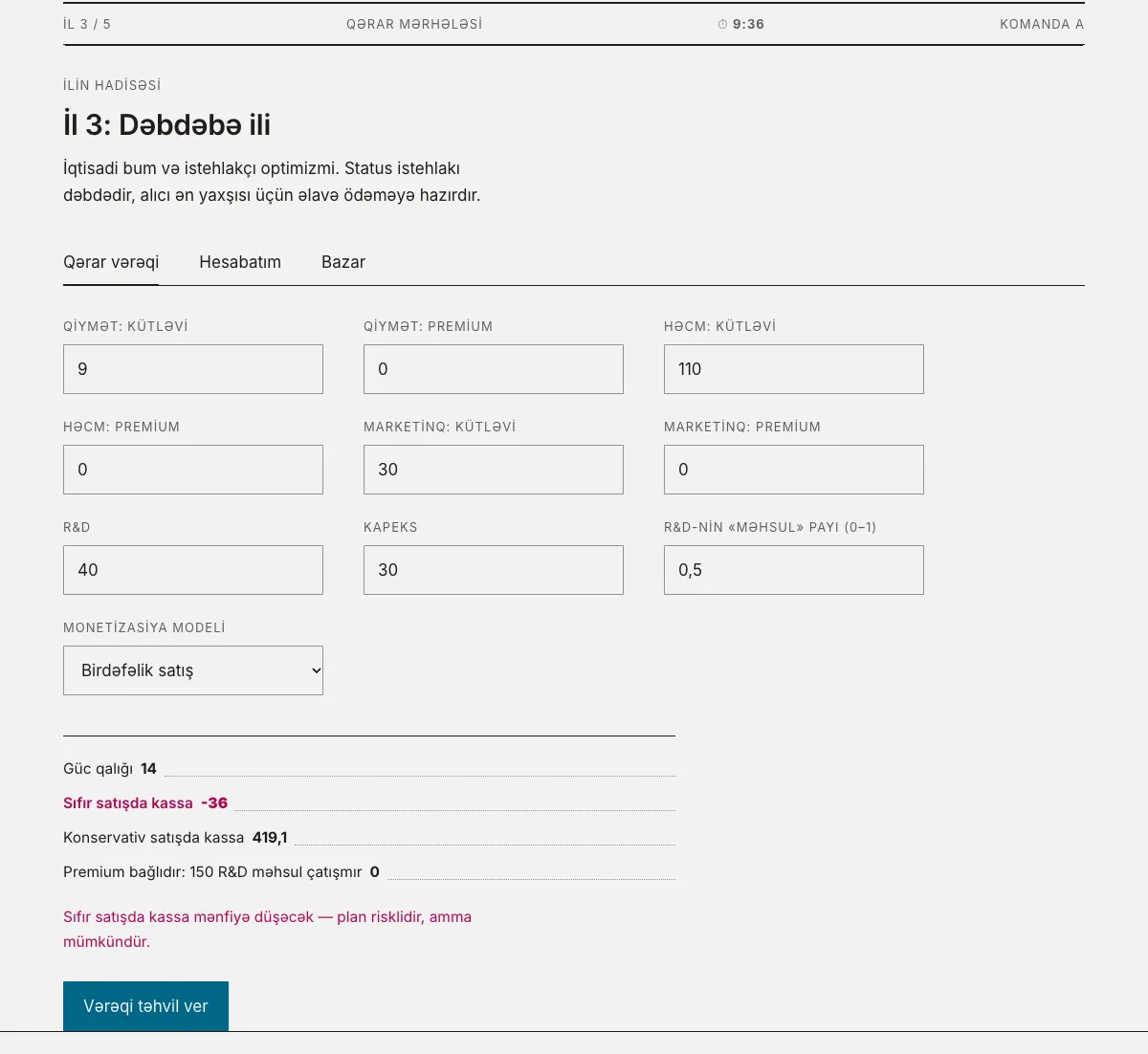
Team screen: the annual plan is submitted at the same time as the competitors’.

The first conversation and a demo game are free.

For the client · the problem

Everyone owns their own area. Nobody owns the value of the company.

Finance guards the cash, sales hold the volume, production asks for capacity. Each is right in their own area. The company still loses: saving on development today turns into a lost market two years later.

Reports show this late. In MESE 2.0 it shows within five rounds, because each year’s decisions come back the next year.

How the game works

Five years. One annual plan per round.

Each team runs a company. The competitors are the other teams in the same market, not a computer.

Once per game year, each team submits its plan at the same time as the others:

  • prices in the mass and premium segments;
  • marketing and R&D budgets;
  • capacity: build now or work with what you have;
  • the business model: one-off sales or a subscription.

Every year the market brings an event: expensive raw materials, broken supply chains, a rate hike, viral hype. Nobody knows it in advance. The team whose company is worth more at the end of year five wins. The market rewards recurring revenue, growth and spare capacity, and punishes a “sold-off future”.

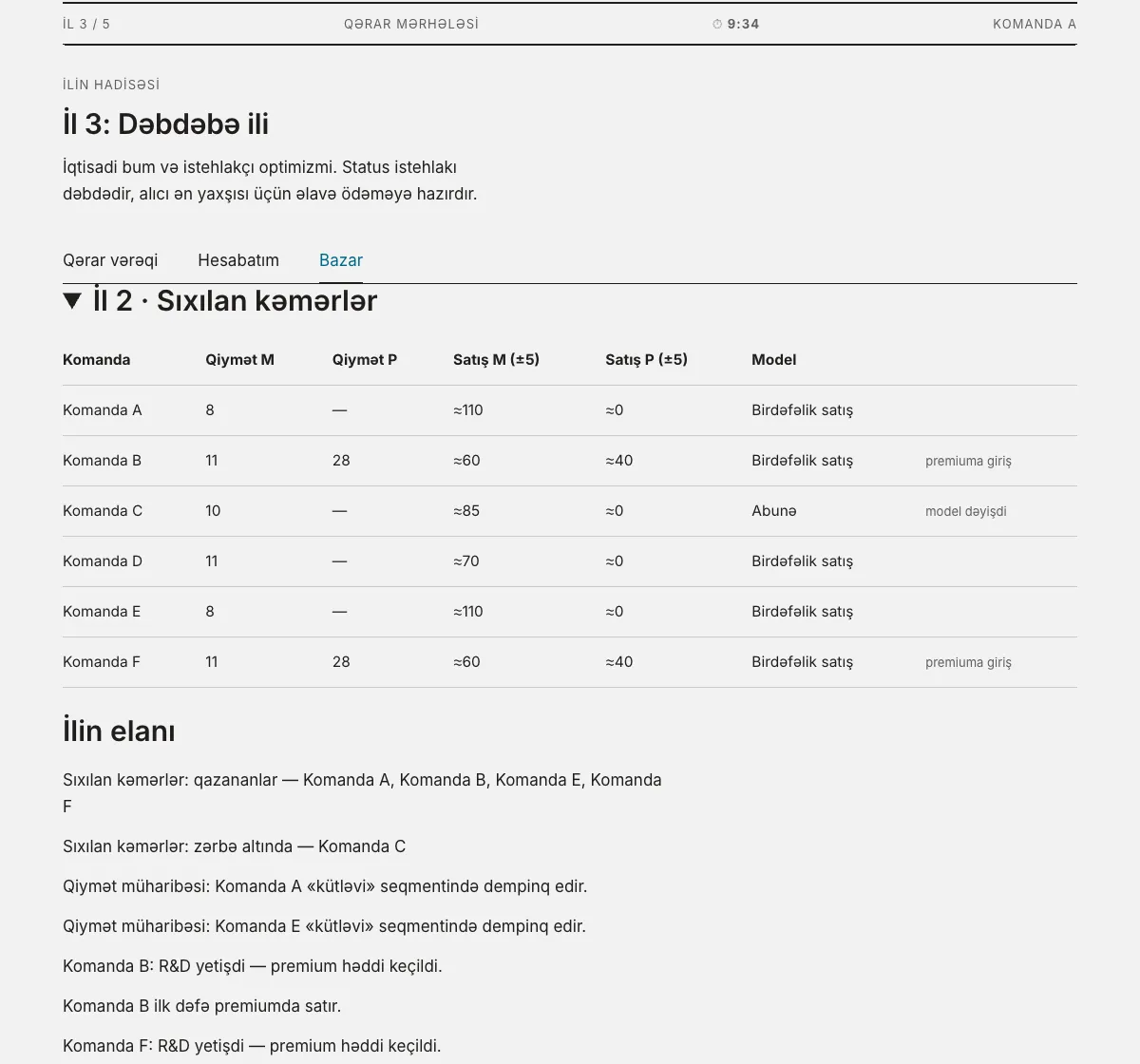
Year results: prices, sales and business models of all teams, plus market events.
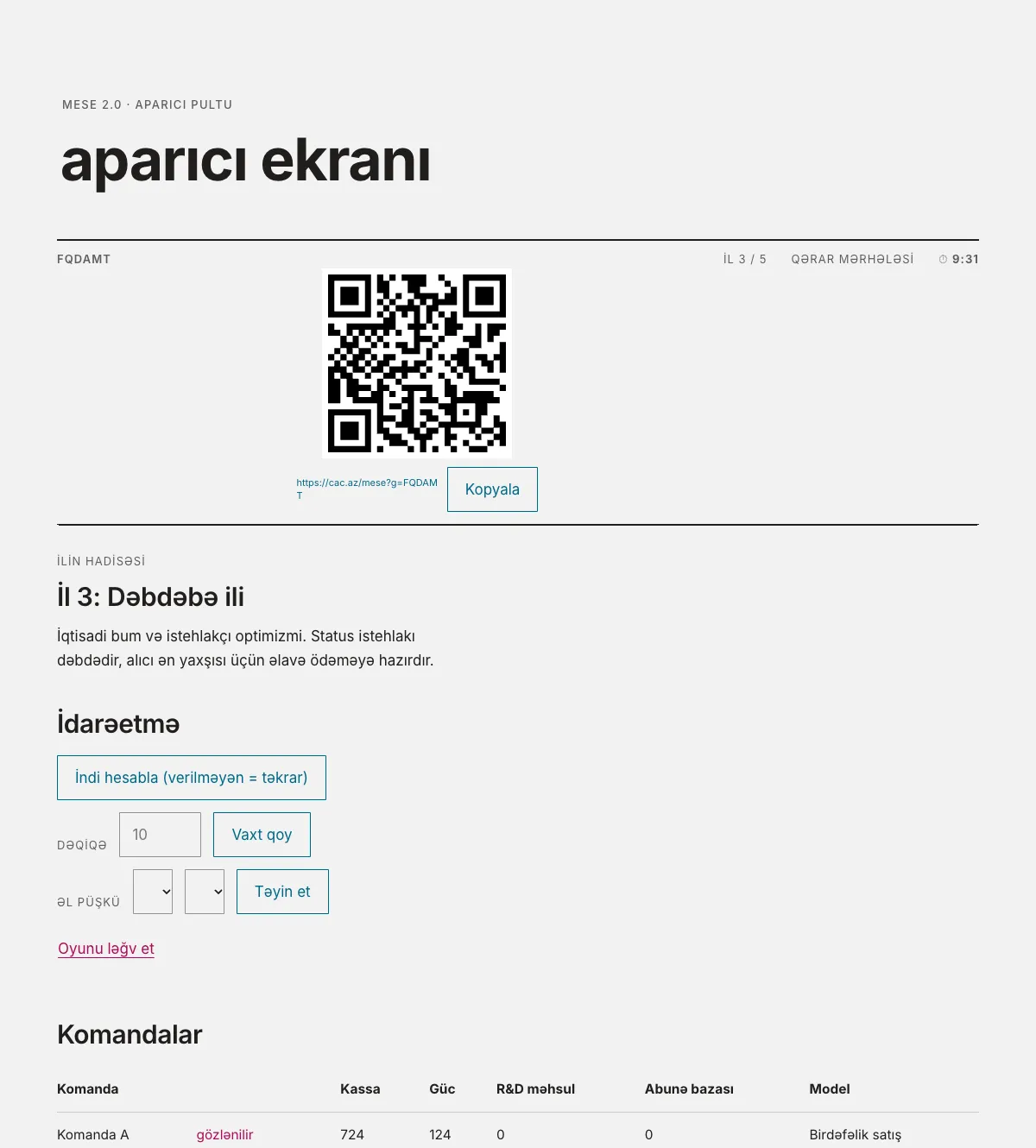
Facilitator screen: round timer, submitted plans, the market event.

What becomes visible

The game is the occasion. The debrief shows how the team decides when mistakes have a real cost.

Decision horizonstrategyDoes the team sacrifice year five for year one.
Financial logicmoneyDo non-finance managers understand what the company’s value is made of.
Decisions under uncertaintyriskWhat happens to the plan when a market event hits.
Agreement in the teamprocessWho decides, who stays silent, how numbers and opinions clash.
Reading competitorsmarketDoes the team watch its rivals or play against itself.
Deadline disciplinetimeDoes the team submit on time. If it misses the deadline, last year’s plan is repeated.

Debrief

We never run MESE 2.0 without a debrief.

Right after year five, a CAC trainer debriefs the game using its data: each team’s decisions year by year, their consequences, and the moment strategy and action parted ways. The debrief takes 30 to 60 minutes.

  1. Facts. Teams see their decisions and final value side by side with their rivals.

  2. Causes. Why they decided that way: who proposed it, what was not discussed, what they knew and ignored.

  3. Transfer. Which of these decisions the team makes in real work, and what it changes from Monday.

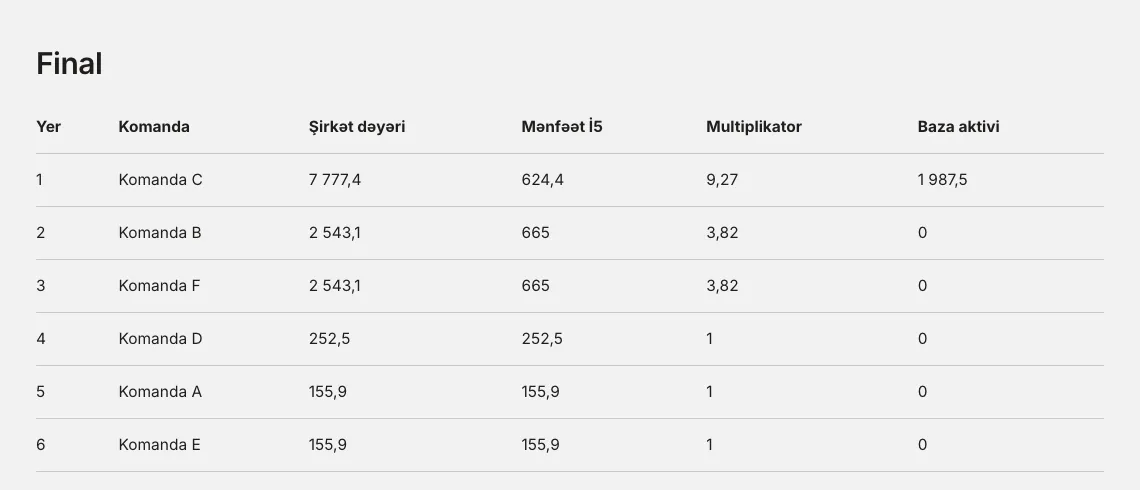
Final of a test game: team C made less profit in year five than B and F, yet its company is worth three times more thanks to its subscriber base. These are the gaps we debrief.

Two sides of one session

What each side gets

For participants

You are on the company’s leadership team

Every game year the team argues, calculates and submits its plan. Within minutes you see how the market answered you and your rivals. No lectures, no slides: just decisions and their consequences.

  • a model of how decisions add up to the value of a company;
  • practice arguing about numbers with colleagues, with no risk to the real business;
  • your own conclusions, not someone else’s advice.

For the client

Data on the team, not impressions

The game records every decision. So the debrief and the conclusions rest on what the team did, not on what it says about itself.

  • a record of the game: every team’s decisions and results by year;
  • the trainer’s conclusions: what the game showed about the team;
  • recommendations: what to develop and in which format — a programme, a session, coaching;
  • a game tailored to your context: market events, language, round timing.

Format

We tailor the scenario and timing to your goal.

Participantsup to 6 teams of up to 5 people — up to 30 participants
Time1–1.5 hours of play, 30–60 minutes of debrief
LanguageAzerbaijani, Russian, English
Wherein the room or online, in a browser
Equipmenta laptop or phone per team, a screen for the facilitator
Facilitated bya CAC trainer
Priceon request

When clients book it

When MESE 2.0 helps most

Before a strategy session

First see how the team decides, then discuss strategy.

In a leadership development programme

Financial logic without a finance lecture.

With a new management team

Quickly see the roles and how people reach agreement.

When assessing a talent pool

Behaviour in decisions instead of self-descriptions.

Questions

Frequently asked questions

Do participants need to know finance?

No. The rules take 15 minutes to explain; the team picks up the rest as it plays. That is exactly why MESE 2.0 is useful for managers outside finance.

Can it run online?

Yes. The game runs in a browser: each team joins via a link with the game code, and the facilitator runs it from their own screen.

Can it be adapted to our industry?

Market events and game settings are adjusted to your goal. We agree the scenario in the first conversation.

How is this different from team building?

It is a working format. The value is in the debrief, not the game: what it shows about your team and what to do about it.

Request

Plan a MESE 2.0 session

Tell us what you are trying to solve. We will pick a scenario and show you a demo game.