
1. Home
  2. Products
  3. Dream

Team game · communication

Dream

One story cut into frames. Everyone sees only their own frame and can only describe it in words. The group rebuilds the order by talking, and the debrief shows who gets heard and how the group reaches agreement.

  • 8–20 players
  • 30–45 minutes of play + debrief
  • AZ · RU · EN
  • from a phone
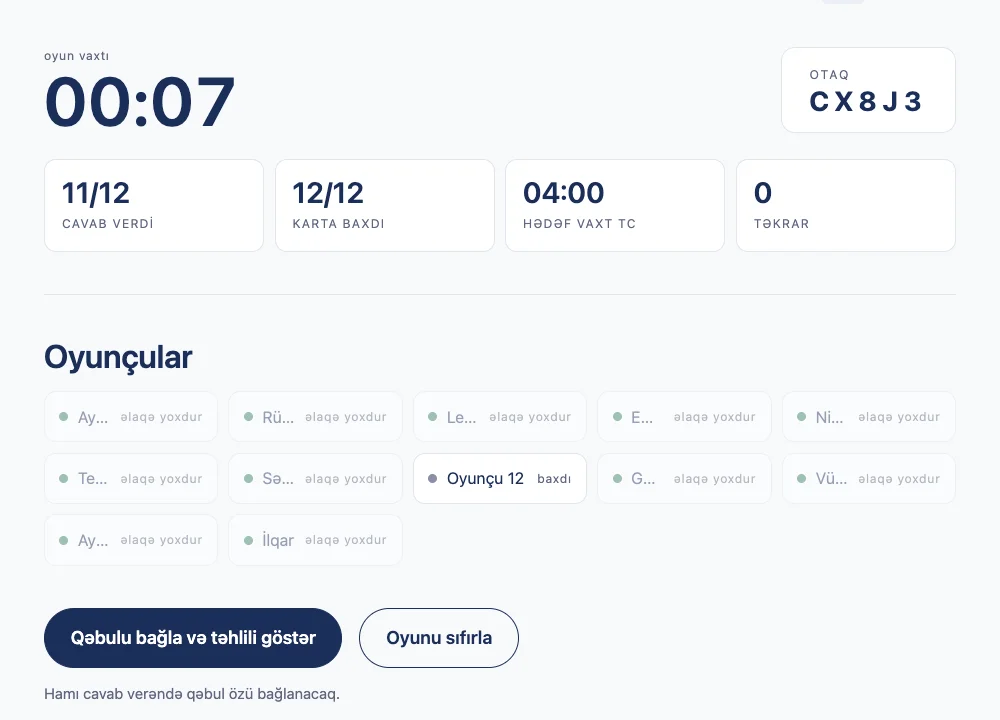
Facilitator console: room code, time, and who has already answered.

The first conversation and a demo game are free.

For the client · the problem

Everyone has information. Nobody has the whole picture.

In a large group everyone knows their own piece: their department, their project, their client. Until the pieces come together, decisions are made blind, and loud voices drown out the people who hold the missing detail.

In Dream you see this within half an hour: the group either builds the shared story or splits into parts that never meet.

How the game works

One story. One frame each. Words only.

The facilitator opens a room and reads out the code. Players join from their phones, and each gets one frame of the shared chain.

From then on, talking decides everything:

  • a frame opens for a minute and then hides again; you can open it as often as you like, and the number of openings goes into the debrief;
  • showing your screen is not allowed, only describing in words;
  • the group argues about what comes first, and each player submits their frame’s position in the chain;
  • the facilitator closes submissions, and the server does the scoring.

Frame sets are never published, each picture arrives through a one-time link, and the server keeps score: nobody can peek at someone else’s frame from the browser.

What becomes visible

The score is the occasion. The debrief shows how the group speaks and listens.

Hidden leadersrolesThe order is built not by whoever has the title, but by whoever gets heard.
CooperationgroupDoes the group build a shared picture or split into halves.
Precise speechcommunicationDoes a person describe the frame so it is understood the first time.
ListeningattentionDo the quiet people who hold the key detail get heard.
TimepressureWhat happens to the conversation as time runs out.

Debrief

We never run Dream without a debrief.

The debrief is on everyone’s screen: the correct order, the frame strip, the final score and five questions to discuss. A CAC trainer leads the group through them: who built the order, who went unheard, what got in the way. The debrief takes about 30 minutes.

  1. Facts. The group sees the correct order next to its own chain: where it matched and where it did not.

  2. Causes. Who took charge of the order, who was interrupted, where the group split.

  3. Transfer. Where information sits in pieces at work in the same way, and what to change in meetings.

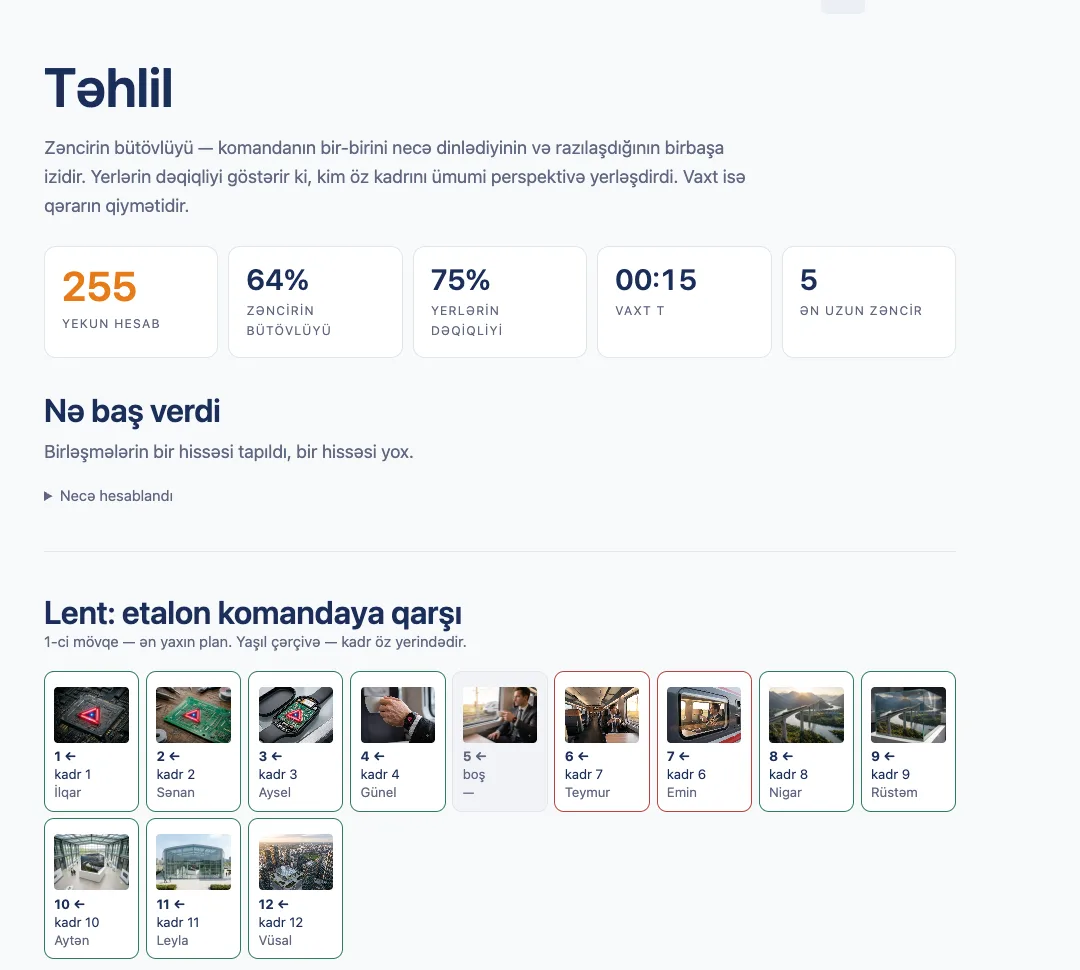
Debrief: score, chain integrity, position accuracy, and the frame strip against the reference.

Two sides of one session

What each side gets

For participants

You hold a piece of the story everyone needs

Everyone sees only their own frame and knows the story will not come together without them. A minute per frame, talk, argument, and the moment everything falls into place.

  • practice in precise, short speech;
  • a sense of how a group hears, or fails to hear, one person;
  • a real conversation with colleagues from different departments.

For the client

How your group builds a shared picture

The game records answers and frame openings. The debrief rests on what the group did, not on how it felt.

  • game results: score, accuracy, time and the frame strip;
  • the trainer’s conclusions on communication, roles and leaders in the group;
  • recommendations: what to develop and in which format — a programme, a session, coaching;
  • a format for a large group that fits into a forum or a programme.

Format

We tailor the scenario and timing to your goal.

Participants8–20 players, one shared story
Time30–45 minutes of play, about 30 minutes of debrief
LanguageAzerbaijani, Russian, English
Wherein the room, on phones
Equipmenta phone for each player, a screen for the facilitator
Facilitated bya CAC trainer
Priceon request

When clients book it

When Dream fits best

Warming up a large group

Twenty people start talking to each other within minutes.

Team building

See the roles and informal leaders in the group.

A conversation about communication

Precise speech and listening, shown on a live example.

Part of a programme

A stand-alone session or a block inside a training.

Questions

Frequently asked questions

Can players show their frame?

No. Words only. That is exactly how you see the way the group passes information along.

How many people can play?

From 8 to 20 in one room.

What do you need to run it?

Phones for the players and a screen for the facilitator. The room stays open as long as the facilitator’s console is open.

Request

Plan a Dream session

Tell us about your group and your event. We will pick a format and show you a demo.