
1. Home
  2. Products
  3. "Dilemma"

Team game · trust and decisions

"Dilemma"

Trust pays, for as long as you are trusted. Two teams choose seventeen times, at the same moment: share or take. After the game, the debrief shows how your people build trust and what a one-round gain really costs.

  • two teams of any size
  • 20 minutes of play + debrief
  • AZ · RU · EN
  • phones and a shared screen
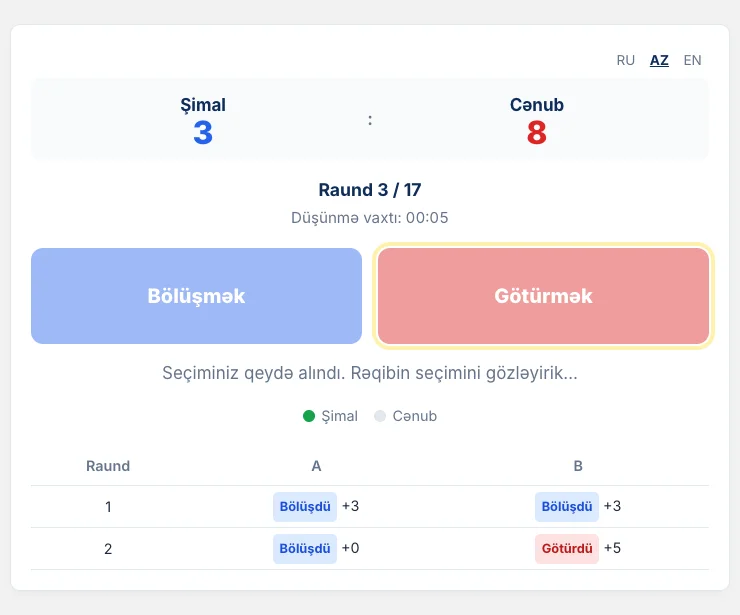
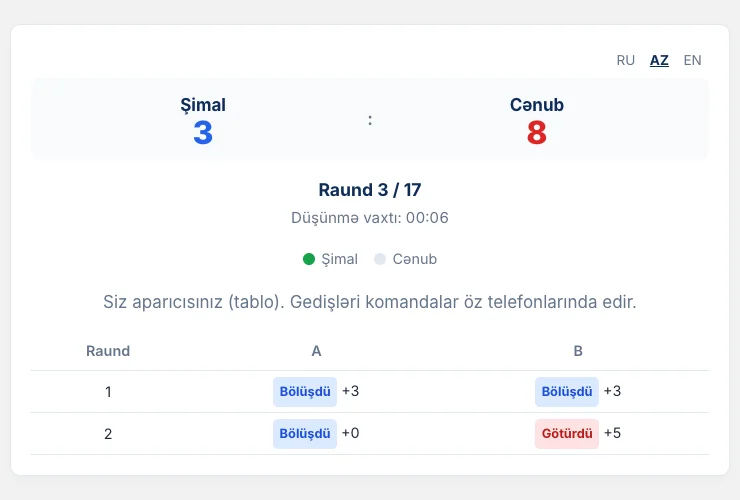
Team screen: two buttons, the score and both sides’ move history.

The first conversation and a demo game are free.

For the client · the problem

Deals fall apart over trust, not numbers.

Departments, partners and suppliers face the same choice every day: give ground for the shared result, or take their share now. One “smart” move, and the partner starts defending itself. From then on, both sides lose.

At work this chain stretches over months. In “Dilemma” it plays out in twenty minutes, on a score everyone can see.

How the game works

Seventeen rounds. One choice per round.

Two teams play against each other from their phones. The facilitator puts the score and every move on a shared screen.

Each round, the team agrees internally and presses one of two buttons:

  • both share: 3 points each;
  • both take: 1 point each;
  • one takes, the other shares: 5 points to the taker, 0 to the one who was let down.

Teams choose at the same moment and see the other side’s move only after making their own. Talking to the other team is not allowed: teams communicate only through their moves. The server keeps score, and no round can be replayed.

The facilitator’s shared screen: score, round and every move. In round two, team A shared and team B took.

What becomes visible

The score is the occasion. The debrief shows how the team handles trust.

TrustrelationshipsWhich move the team opens with, and what it takes for it to trust again.
Reaction to betrayalbehaviourDoes the team retaliate, forgive or shut down.
HorizonstrategyDoes the team remember there are seventeen rounds, not one.
Group decisionsprocessWho in the team proposes to “take”, and who stops it.
Signals without wordscommunicationHow the team reads the other side when talking is not allowed.
The price of winningvaluesWhat matters more: beating the other team or scoring more together.

Debrief

We never run “Dilemma” without a debrief.

Right after round seventeen, a CAC trainer debriefs the game from the move history: where trust appeared, where it broke, and how many points that cost both teams. The debrief takes 20–30 minutes.

  1. Facts. Teams see every move and the score, and compare it with what mutual trust would have given: 51 points each.

  2. Causes. Who proposed taking, why the team did not forgive, what it understood about the other side and what it imagined.

  3. Transfer. Where the team behaves the same way at work: with another department, a partner, a client.

Two sides of one session

What each side gets

For participants

Your team against the one next to you

Seventeen times the team argues and chooses. Seconds later you see what the other side chose. No lectures: just your decisions and their price.

  • first-hand experience of how fast trust breaks and how hard it is to win back;
  • a clear model of game theory, without formulas;
  • your own conclusions about yourself and your colleagues.

For the client

How your people behave when cheating pays

The game records every move. The debrief rests on what the teams did, not on what they think of themselves.

  • the game history: both teams’ moves, round by round;
  • the trainer’s conclusions on trust, leadership and group decisions;
  • recommendations: what to develop and in which format — a programme, a session, coaching;
  • a short format that fits into any event.

Format

We tailor the scenario and timing to your goal.

Participantstwo teams of any size
Time20 minutes of play, 20–30 minutes of debrief
LanguageAzerbaijani, Russian, English
Wherein the room
Equipmenta phone per team, a shared screen for the facilitator
Facilitated bya CAC trainer
Priceon request

When clients book it

When “Dilemma” helps most

Before negotiations

See how the team bargains before it sits down with a partner.

Between departments that clash

Show the cost of “us versus them” on the scoreboard, not in words.

To open a forum or strategy session

Twenty minutes, after which the room talks about trust in concrete terms.

In a leadership programme

Group decisions under pressure, and the role of the person who says stop.

Questions

Frequently asked questions

Do you need to explain game theory first?

No. The rules fit in three lines and take a couple of minutes. We unpack the theory after the game, using your own moves.

How many people can play?

There are two teams of any size: from two people each to a whole room split in half.

Can the teams agree with each other?

No. Teams communicate only through their moves. That is exactly how you see the way they read each other.

Can it fit into our event?

Yes. The game takes 20 minutes and the debrief 20–30; you need phones and a screen. It works well to open a forum, a training or a strategy session.

Request

Plan a “Dilemma” session

Tell us about the event you are planning. We will suggest where “Dilemma” works best and show you a demo.